
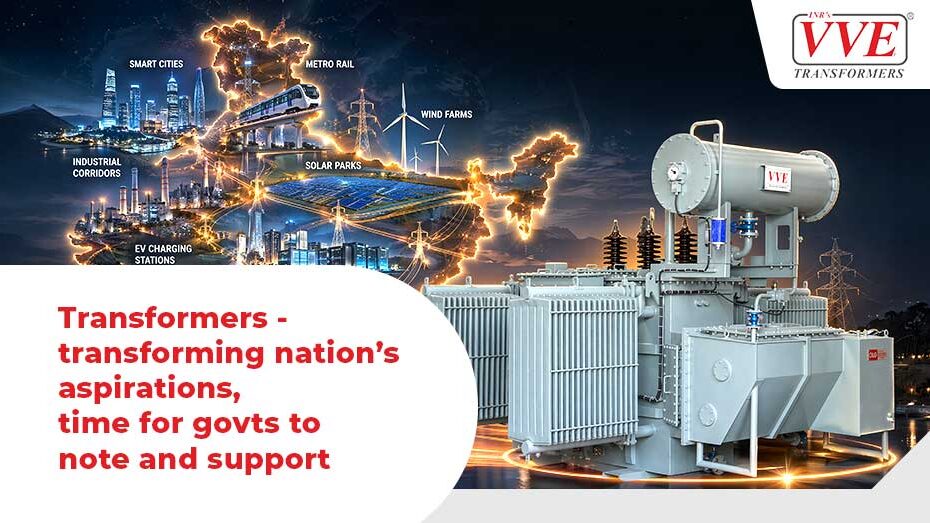
India’s economic ambitions are enormous, aligning with a vision for 2047. Manufacturing expansion, renewable energy integration, electric mobility, urbanization, digital infrastructure, and industrial corridors all depend on one fundamental requirement: reliable electricity.
At the centre of that electricity ecosystem sits an often-overlooked component — the transformer. If India’s power sector is undergoing a transformation, the transformer industry is undergoing one as well.
Demand growing from every direction
Traditionally, the demand drivers of transmission and distribution networks have been the conventional manufacturing, logistics, infra, and massive service sector installations. But today, the landscape is seeing a fast addition in the form of sunshine sectors, and technologically transforming conventional sectors. These include:
- Renewable energy parks
- Industrial manufacturing clusters
- Data centres
- Metro rail systems
- Electric vehicle infrastructure
- Smart urban growth centres
- Mammoth infra projects
Each of these requires specialized transformer solutions capable of delivering efficiency, reliability, and long operational life. The challenge is no longer merely building capacity. It is building smarter capacity.
Focus on efficiency, not just expansion
India loses significant amounts of electricity through technical and commercial inefficiencies. While transmission upgrades receive attention, distribution infrastructure often requires equal focus.
High-efficiency transformers can reduce losses across the network while improving power quality for consumers and industries. Investments in modern transformer technologies therefore create benefits that extend far beyond utilities.
Accelerate smart grid adoption
It is undisputed fact that the future grid will be data-driven. Governments are mulling accelerating the deployment of smart transformers that formidably monitor load conditions, temperature, faults, and other performance parameters, all real time. Such systems enable predictive maintenance, faster fault detection, and more reliable power delivery.
Recent initiatives by utilities to deploy advanced transformer configurations demonstrate how innovation can improve safety, monitoring, and operational efficiency.
Encourage domestic manufacturing excellence
India today finds itself in an advantageous position, with the opportunity to emerge as a global transformer manufacturing hub, spotted in the horizon. The policy of course needs to be fortified and updated in order to strengthen:
- Advanced manufacturing capabilities
- Export competitiveness
- Research and development
- Testing and certification infrastructure
- Skilled workforce development
As global demand rises due to grid modernization and renewable energy expansion, Indian manufacturers are well-positioned to serve both domestic and international markets.
Standardization and quality enforcement matter
Not all transformers deliver the same long-term value. Stronger adherence to quality and safety standards, efficiency benchmarks, and testing requirements can help utilities and industries reduce expensive failures while improving network performance. Greater emphasis on lifecycle value rather than lowest-price procurement can also encourage innovation and quality investments.
Building the backbone of India’s growth
The next phase of India’s development will depend on the strength of its electrical infrastructure. Roads move goods. Ports move trade. Planes more a lot more. Digital networks move information. But none of them function without dependable power.
Companies such as VVE Transformers represent the manufacturing ecosystem that supports this transformation through distribution, power, dry-type, and solar transformer solutions built to national standards. With decades of engineering experience and a growing focus on reliability and efficiency, such manufacturers are part of the broader industrial capability India will need in the years ahead.
The future of India’s power sector will not be defined solely by how much electricity is generated. It will be defined by how effectively that electricity is transmitted, distributed, monitored, and utilized. The transformer industry sits at the heart of that mission.