
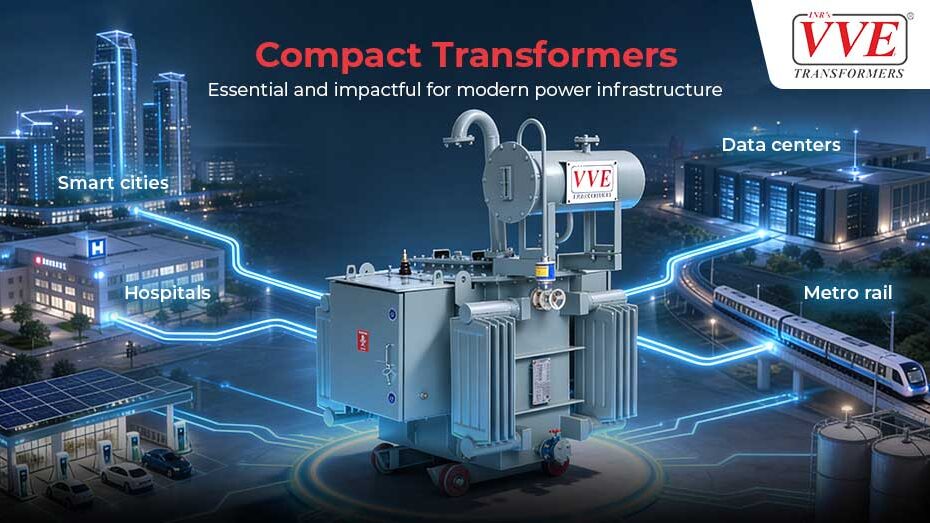
Across the world, urban infrastructure is evolving rapidly. Smart cities, data centers, hospitals, industrial parks, renewable energy installations, metro rail systems, and high-density commercial developments are all being developed or operated on a large scale. But behind this humungous economic activity, the most concerning component is the reliable power. There is a ubiquitous demand for high-quality power within increasingly constrained spaces.
As the challenge becomes more formidable, it is directly influencing the way electrical infrastructure is designed. Traditional large-footprint transformer systems are gradually giving way to compact, high-efficiency transformer solutions that are capable of delivering the same or even higher performance with more safety, more flexibility, and higher operational efficiency.
Compact transformers are no longer seen as space-saving options. They are becoming critical tools of modern infrastructure development, in space-efficient and cost-efficient manners.
Space-efficient power systems, the need of the hour
Across industries, available operational space is shrinking while energy demand continues rising.
Commercial buildings now allocate more space to operational utilities, HVAC systems, digital infrastructure, and parking facilities. Industrial facilities seek higher production density within existing footprints. Urban power distribution networks are also becoming more complex due to rapid urbanization and growing electrical loads.
This is where compact transformer technologies are creating measurable advantages.
Modern compact and unitized substations integrate transformers, switchgear, protection systems, and associated electrical components within highly optimized configurations. These systems significantly reduce installation footprint while simplifying deployment and maintenance requirements.
Compactness, more than just size
One common misconception is that compact transformers simply reduce physical dimensions. In reality, modern compact transformer engineering involves significant advances in:
- Thermal management
- Core efficiency
- Cooling optimization
- Insulation
- Noise reduction
- Safety integration
- Smart protection
Manufacturers are increasingly using step-lap CRGO cores, advanced winding techniques, precision insulation systems, and optimized cooling designs, which will improve efficiency besides reducing operational losses.
These advancements extend a host of benefits to the end users:
- Lower no-load losses
- Improved voltage regulation
- Reduced heat generation
- Better operational reliability
- Reduced maintenance requirements
- Higher safety standards in compact environments
- Significant long-term savings
Compact systems matter in critical environments
Modern infrastructure projects increasingly require transformers capable of operating safely within sensitive or high-density environments.
Hospitals, IT parks, educational institutions, commercial complexes, and industrial facilities often cannot accommodate large outdoor transformer yards. Compact substations and dry-type transformers help address these constraints by enabling safer indoor or space-optimized installations.
Additionally, renewable energy integration is fueling the demand for compact transformer systems that can buttress the decentralized energy distribution. Solar installations, EV infrastructure, and other energy systems require highly adaptable transformer solutions capable of handling fluctuating loads efficiently.
Modern manufacturing drives better performance
The compact transformer phenomenon is closely linked to advancements in transformer manufacturing. Currently, the manufacturers are increasingly depending on CNC fabrication, vacuum drying, testing facilities and computer-aided designs, copper winding systems, etc.
These technologies improve durability, reduce failure risks, and enhance operational consistency under varying load conditions. The industry’s emphasis on BIS-compliant, energy-efficient, and application-specific transformers also calls for the need to address the growing demand for customized power solutions.
The future lies in being smart and simple
As infrastructure grows expansive by the day, and energy systems become more distributed, compact transformers will play an increasingly important role in enabling scalable and efficient power delivery.
Companies such as VVE Transformers are part of this ever-changing and evolving landscape where they pioneer the manufacturing of customized distribution transformers, compact substations, dry-type transformers, and power transformers, all designed to meet modern industrial, infrastructure, and societal requirements. The focus on efficiency, durability, and customization manufacturing is in line with broader industry trends that shape the future of power systems.
The next generation of power infrastructure will not simply demand higher capacity. It will demand smarter, safer, and more space-efficient systems capable of supporting increasingly complex operational environments.