
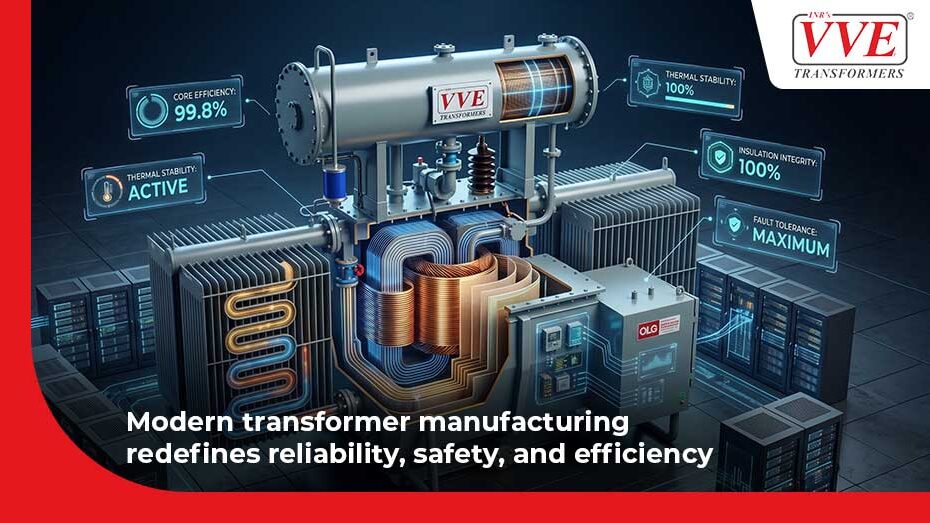
The transformer industry is undergoing a major technological shift. What was once considered a conventional electrical product category is now becoming an advanced engineering domain driven by efficiency standards, renewable energy integration, industrial automation, and smart infrastructure demands.
Today’s transformers are expected to do far more than simply step voltage up or down. They must operate continuously under varying loads, withstand environmental stress, reduce energy losses, support renewable integration, improve safety, and deliver long-term operational reliability.
This growing complexity is reshaping transformer manufacturing globally.
Rising demand – transformative & tactical
The expansion of renewable energy, electric mobility, industrial automation, urban infrastructure, and data centers has significantly increased global transformer demand. Recent industry reports indicate that power infrastructure expansion and grid modernization are creating severe transformer supply pressures worldwide.
But alongside rising demand, customer expectations are also evolving.
Discerning end users today expect transformers to offer:
- Higher energy efficiency
- Lower lifecycle costs
- Enhanced operational safety
- Compact and flexible designs
- Better thermal performance
- Reduced maintenance needs and costs
- Greater durability under fluctuating loads
This has accelerated innovation across transformer design and manufacturing processes.
Core design calls for efficiency
One of the most important trends in transformer manufacturing is the growing focus on reducing energy losses.
Modern transformers increasingly use high-grade CRGO silicon steel cores, optimized magnetic flux designs, and precision copper winding systems to reduce no-load and load losses.
Since transformers operate continuously for years, even small improvements in efficiency can create substantial energy savings over the equipment lifecycle.
Manufacturers are also focusing heavily on thermal optimization because excessive heat remains one of the leading causes of transformer degradation. Advanced cooling systems now help improve heat dissipation and operational stability under demanding conditions.
More stringent safety standards
Another major shift is the increasing emphasis on operational safety. Segments such as healthcare, IT parks, commercial infrastructure, pharmaceuticals, and renewable energy require transformers capable of operating safely in sensitive environments. This is triggering the demand growth of dry-type transformers, advanced insulation systems, and smart protection mechanisms.
Modern transformer manufacturing today combines enhanced insulation technologies and vacuum drying system, monitoring systems and protection and mitigation mechanisms, all rigorously going through testing protocols. These rigorous testing processes have also become increasingly important, particularly for transformers deployed in mission-critical infrastructure. Manufacturers now perform extensive insulation resistance testing, high-voltage testing, thermal testing, and quality validation to ensure operational reliability.
Customization, a competitive advantage for players
The era of one-size-fits-all transformers is passé. Industries today demand highly customized transformer solutions suiting specific operational conditions, voltage requirements, installation constraints, and environmental factors. Solar plants, industrial facilities, commercial buildings, and utility networks often require application-specific transformer engineering.
This trend has strengthened the importance of manufacturers capable of delivering flexible and customized solutions rather than standardized equipment alone.
VVE Transformers has well positioned itself through evolving manufacturing ecosystem that focus on customized distribution transformers, power transformers, dry-type transformers, compact substations, and application-oriented electrical solutions. Its infrastructure includes testing facilities, vacuum ovens, precision manufacturing systems, and BIS-compliant production capabilities aligned with modern industry expectations.
Transformers are strategic infrastructure assets
The future of transformer manufacturing is no longer just about electrical conversion. It is about enabling smarter infrastructure, safer operations, energy efficiency, and long-term reliability.
As industries become more power-intensive and operational continuity and sustenance become increasingly critical, there will be more stress on transformer quality and engineering precision that directly influence business performance.
For end users, the value of modern transformers lies not only in durability or electrical performance, but in the ability to support evolving operational demands safely, efficiently, and sustainably for decades ahead.